1) X is the term used in the United Kingdom to refer to a domestic league cricketer, on whom, any quotas setting maximum numbers of such foreign players in teams are deemed illegal under EU law. This term, which has obtained its name from the rule known as X ruling, has allowed English county cricket clubs to employ the services of a multitude of overseas cricketers. What is X?
2) The name calamari is given to Mediterranean dishes involving squid, and it is a popular food in many parts of the world. The cricketer X was involved in what is probably the most bizarre stoppage in the history of cricket, when 'calamari stopped play'. X bowled to Daryll Cullinan, who hit the ball for six, straight into a pan of frying calamari in a kitchen (according to Wisden). Even after ten minutes the bowler couldn't grip the ball, and eventually it had to be replaced. Who?
3) The cricketer X, who was known as Vinnige Fanie by his fans, was a judge in the 1995 Miss World pageant in Sun City. In 2003, renowned cricket writer Trevor Chesterfield published a biography of X entitled X: Portrait of a Test Bowler. ID X.
4) X suffered from epilepsy. When he helped Kerry Packer start World Series Cricket signing up many of English, West Indian and Pakistani cricketers, a move which cost him the captaincy of England, and a number of commentators ridiculed him, questioned his judgment in the matter and speculated that epilepsy impaired his ability to make decisions. After that, X was offered a "job for life" by Packer as a commentator during Nine's cricket coverage. Who was the cricketer X?
5) Finally, a sitter for some Biz enthusiasts :)
X is a stadium in South Africa, which was renamed to its present name after the leading sports provider in South Africa, Y, bought shares in the stadium. It is the home ground of the Titans Cricket Team, formerly known as Northern Transvaal. ID X and Y.
Monday, February 8, 2010


Tuesday, December 29, 2009
A tribute to the GOD!
25th June 1983 – Perhaps the most significant moment in India’s cricket history. The historic significance of that day is known to everyone of us. It brought about a drastic change in the way the game is perceived in the nation, and it was the first real reason for cricket becoming a rage among the masses. But six years later, the 15th of November turned out to be a red-letter day for not just Indian cricket, but the whole world of cricket.

A tiny bloke, barely sixteen years of age, with full of curly hair, made his international debut in a Test against archrivals Pakistan at Karachi. None in their wildest dreams would have expected him to become what he is today. Since then, he has enraptured billions around the world with his ineffable strokeplay. He is a phenomenon. He is a god himself to many. He is the little master. He is Sachin Ramesh Tendulkar.
Sachin Tendulkar has been the most complete batsman of his time. His batting is a blend of perfect balance, immaculate technique and impeccable stroke-making. He is one person who is capable of bringing his whole nation to a standstill. When he enters the wicket, there arises an unprecedented silence full of prayers of a billion people, the TRP ratings of the TV channels soar to unimaginable levels, and the whole burden of a billion people rests on his small shoulders.
The Bloody Beginning:
In the final test of his maiden international series in Sialkot, he was hit on the nose by a bouncer, but he declined medical assistance and continued to bat even as he gushed blood from it. The pace trio of Imran, Wasim and Waqar dealt him with contempt, and tested him by dishing out innumerable blows to his body. The way in which Sachin handled them made everyone sit up and take note of the Mumbaikar. This tour showcased the underlying grit and determination that betrayed that tiny frame of his.
On the 16th of December 1989 at Peshawar, a legend was born. It was not in the original plan to include Sachin for the ODI leg of the tour, but he played since it was an unofficial match, and Kapil Dev was nursing a stiff neck. Eighteen deliveries changed everything. In that time he made an unbeaten 53, and in the process, tore apart Abdul Qadir for 27 runs in a single over, with three sixes in a row. The then captain, Kris Srikkanth, told referring to the one-day series, "The little bugger must play now." The little bugger has been playing ever since that day.
When Merv Hughes told Allan Border, “This little prick's going to get more runs than you, AB.” in Sachin’s first tour Down Under in 1991-92, fear showed up in the burly Australian’s words. Sachin’s ton at the fast and bouncy WACA track, is perhaps the best innings of his lifetime as told by the master himself. He has ever since remained an egregious thorn in their flesh indeed. His most memorable performances have come predominantly against Australia, the most dominant and feared team of his era. He holds almost every record in the book. He holds the record for the maximum number of Test and ODI runs and centuries. His records are monumental, and it is unlikely that his aggregate of 30000+ International runs will ever be surpassed.
He is renowned for his picture-perfect straight drive, often completed with no follow-through. Sir Donald Bradman, considered by many the greatest batsman of all time, considered Tendulkar to have a batting style similar to his. In his biography, it is stated that "Bradman was most taken by Tendulkar's technique, compactness and shot production, and had asked his wife to have a look at Tendulkar, having felt that Tendulkar played like him. Bradman's wife, Jessie, agreed that they did appear similar."
What makes this man so special and adorable? Well, everything about him. He is a perfect role model if you were ever looking for one. He has his head firmly on his shoulders in spite of all his towering achievements. The best part is that, he is still hungry for a lot more. Nothing means more to him than representing his country in what he does best – play cricket. For a person like him, no praise is ever enough. After twenty long years in the game, he still continues to live in a bubble unperturbed and unaffected by controversies and just lets his bat do the talking. Sometimes, all this makes you wonder – Is He Human?
"I have seen God. He bats at number 4 for India in Tests."- Mathew Hayden.
Friday, November 27, 2009
Cricket Quiz - 2
1. It is very well known that the great Don has the world record for the most number of aggregate runs in a bilateral test series with a mammoth 974 in the 1930 Ashes. Who holds the corresponding record for a bilateral One-day International series?
2. Connect.
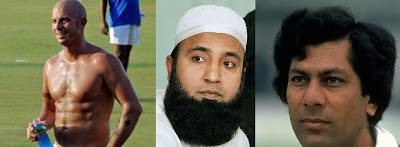
3. Tests:-
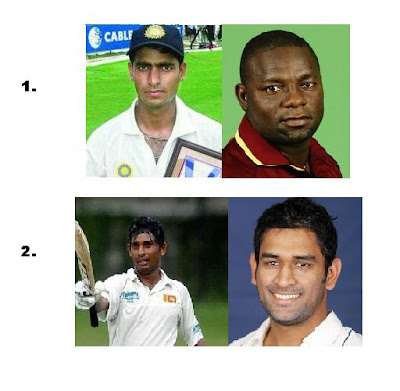
ODIs:- X and Y.
ID X,Y.
4. Who is the only cricketer to score a double century in One-Day Internationals?
2. Connect.

3. Tests:-

ODIs:- X and Y.
ID X,Y.
4. Who is the only cricketer to score a double century in One-Day Internationals?
[Chuck this question now.. Sachin Ramesh Tendulkar rocks :) ]
5. Which famous rockstar once quipped, "I want to play cricket. It doesn't seem to matter whether you win or lose."??
Hint :- With insomnia, nothing is real. Everything is far away. Everything is a copy of a copy of a copy. ;-)
5. Which famous rockstar once quipped, "I want to play cricket. It doesn't seem to matter whether you win or lose."??
Hint :- With insomnia, nothing is real. Everything is far away. Everything is a copy of a copy of a copy. ;-)
Tuesday, November 10, 2009
My first Cricket Quiz!! :)
1. Put fundae about the following partnerships in Test Cricket. :)
i. Warne - Mark Taylor
ii. Kumble - Dravid
iii. Warne - Hayden
2. This made its debut in cricket, in June 1991 in the NatWest Trophy game between Derbyshire and Hertfordshire at Bishops Stortford. But we came to know of this currently defunct entity in cricket much much later. What am I referring to here?
3. Put fundae..

Hint :- This is a WORLD-FAMOUS quote about a truly world-class player, and think what's AB doing here! :)
4. This occured for the first time in Test Cricket in the England vs Zimbabwe test match from Dec-18 to 22, 1996 at Bulawayo. What is its significance? Put fundae..
5. Now, an absolute sitter to end the quiz! :)
X, in his autobiography, Out of My Comfort Zone, states that his teammate Y had noticed that Z had developed a habit of celebrating a wicket by throwing the ball in the air prematurely after taking catches, and instructed his colleagues not to leave the crease too quickly if they happened to be caught by Z.
ID X, Y and Z, and put fundae why X says this. :)
Tuesday, August 11, 2009
The ComBat(s), and 500-1 - Lillee means Business!
Dennis Keith Lillee, the Western Australian speedster was regarded as one of the most fiery fast-bowlers of all time, and arguably the greatest of his generation. He was very well known for his never-say-die attitude in the game. These incidents in the game's history either give us a glimpse into the bad-boy image of Lillee or portay his superb business acumen. Take it either way! :)
The ComBat:
Guys, Don't be tricked into believing that you're reading a cover story on one of the stupidest dogfights in the history of the game. That's not meant for now. Do wait for somemore time. :)

Graham Monoghan was a former club cricketer, a friend and business-partner of Lillee. Taking a cue from the usage of metal supplanting the usage of wood in the making of cheaper baseball bats, he came up with a process which produced a inexpensive cricket bat, which was made of Aluminium. This was actually intended as a cheap replacement for traditional cricket bats in schools and developing countries.
It was the second day of the opening test between England and Australia on the 15th of December, 1979 at the WACA, Perth. The series was a truncated one with only 3 test matches. At the end of the first day, Australia were in some trouble at 232 for 8, with Lillee unbeaten on 11. Out walked Lillee, with the aluminium bat, its trade name being ComBat. This was done by Lillee to use it as a marketing stunt actually, as there were no rules against the use of such a bat then. Lillee had already used the aluminium bat in a test 12 days earlier against the Caribbeans at the Gabba. On that occasion, he was neither objected by the visitors nor did he make any significant impact, as he hit the ball just once though with an emphatic sound, before being dismissed lbw by Joel Garner for nought. In the match at the WACA, the english skipper Mike Brearley did not take it as amusing as the Windies took it.
The trouble came on the fourth ball of the second day, when Lillee hit Botham down the ground for three runs. Greg Chappell, the then Aussie skipper, felt that the ball should have gone to the fence had Lillee used a conventional bat and blaming the metal bat, he sent out the 12th man into the ground with two conventional bats for Lillee. Brearley was complaining by then to the umpires, that the bat was damaging the ball. Lillee refused to budge and packed off the 12th man Rodney Hogg. Realizing that the match had to go on, Chappell took upon the task himself and forced Lillee to bat with a normal bat. Lillee finally hurled away his metal bat and the match resumed.
An Unnoticed offense of Match-fixing:
It was Australia vs England in the third test at Headingley, played between the 16-21 of July, 1981. Australia was in such a strong position to win the match, that some bookmakers in the ground were offering odds of 500-1 for an England victory.

This was flashed on the scoreboard during a break in the game, and when the Aussie players Lillee and Marsh saw this, they felt that was absurd and decided to try out their luck at betting. True to their luck(!), Botham came out and smashed an amazing 149 to set up the match nicely. But still, in the Aussie second innings, with a paltry target of 130 to be achieved, and at the score of 56/1, the expectations everywhere would have been that of the Aussies romping home and taking a lead of 2-0. But that was not what to be. In one of the most dramatic collapses of test cricket history, more so when viewed as the aftermaths of the bookies episode, they lost their last nine wickets for a meagre 55 runs and it was an unlikely English victory by a margin of 18 runs, with Bob Willis finishing with an incredible figures of 8/43. As a result, Marsh and Lillee collected 7500 pounds from the bookies.
Lillee was quoted as saying later, "I would have naturally swapped the money for a win, but Being a small-time punter, I had been unable to resist the juicy 500-1. It was as simple as that."
It was an openly discussed issue but the two men received no official censure. There has never been even a suggestion that the bets affected their performance in the game.
The Real COMBAT - The Infamous Kick:
Now finally, we come to discuss about the ugly dogfight involving Lillee and Miandad. :) It was the 1st game of the 3-match series between Australia and Pakistan in Nov-Dec 1981. Australia held the upperhand throughout the game after they dismissed the Pakistanis for a paltry 62 in their first innings on a bouncy WACA strip. Pakistan were set a monumental target of 543 to win the match in the fourth innings.

Among the greatest players of their generation, Miandad and Lillee could very well have been two peas from the same pod. Instead, they became the bitterest of enemies. When Miandad was batting, he turned Lillee behind square and set off for a single. He collided with the bowler, but witnesses observed that Lillee had deliberately moved into the batsman's path. The blame lay with Lillee, in the eyes of the media and everyone else. As Lillee turned to go back to his mark he maintained that Miandad struck him from behind with his bat; Miandad countered with the claim that Lillee had kicked him as he passed. Lillee then turned to confront Miandad, and Miandad lifted his bat above his head as if to strike him. Wisden described this ugly fracas as "one of the most undignified incidents in Test history".
Saturday, August 8, 2009
The notorious disciplinarian in the game!!
Everyone, who is an ardent follower of cricket, would certainly feel that the Aussies are the worst in terms of their behaviour and on-field discipline. So, by seeing the title of the post, they would certainly expect to see an article on an Oz player. But, that's not to be.
This post is dedicated to Sunil Gavaskar, who is certainly hailed to be one of the best batsmen in the history of world cricket, if not the best.  Even Sachin Tendulkar, according to the old purists, doesn't deserve a better position in the numbers game ahead of Sunny as the greatest batsman from the subcontinent. Cricket is generally termed as gentleman's game and many people say that the Australians are the sole reason for the game's image being tarnished with regard to this comment. But, this argument takes a certain beating when we analyse the career and life of the great Sunny Gavaskar, who hailed from India, considered to be one of the countries where the game is played in the perfectly right spirit. Now, Let's take a plunge into the infamous heroics of the legend.
 Even Sachin Tendulkar, according to the old purists, doesn't deserve a better position in the numbers game ahead of Sunny as the greatest batsman from the subcontinent. Cricket is generally termed as gentleman's game and many people say that the Australians are the sole reason for the game's image being tarnished with regard to this comment. But, this argument takes a certain beating when we analyse the career and life of the great Sunny Gavaskar, who hailed from India, considered to be one of the countries where the game is played in the perfectly right spirit. Now, Let's take a plunge into the infamous heroics of the legend.
THE BIGGEST OF THEM ALL:
It was the first ever cricket world cup in the year 1975, the Prudential World Cup held in England. And what a spoiler of a game it was to open the tournament. It was England vs India on the 7th of June, 1975, at the Mecca of Cricket, Lord's Cricket Stadium. It was a fantastic innings of One-day cricket displayed by the English, scoring a mammoth 334 for the loss of 4 wickets in their allotted 60 overs. But, alas! Their Indian counterparts, Gavaskar in particular, made a huge mess of the new concept of ODIs. Chasing the huge target, India gave such a disappointing exhibition of batting that even their own large contingent of supporters were totally frustrated with it. The culprit was Gavaskar himself obviously, who played a snail-paced innings of an unbeaten 36 while carrying the bat throughout the 60 overs, with he himself playing 174 deliveries. India crawled to 132/3 at the end of 60 overs, playing with absolutely no intent. Anyone who had the class of Gavaskar, would not play with such stupidity unless he himself wished to deliberately do so. It was alleged that he did this deliberately to show his resentment against the appointment of Venkatraghavan as the captain.
At the Melbourne Cricket Ground in the 1980-81 Tour Down Under, when skipper Gavaskar was given out by the Australian umpire Rex Whitehead, he ordered his fellow batsman Chetan Chauhan off the field, refusing to continue with the match. Is this a show of sportsmanship against the very people whom you term, are of unsporty nature?
In the third test against England at the Eden Gardens, India adopted such a defensive tactic under Gavaskar, that even a highly mediocre English bowling attack was made to look deadly. The hostile crowd watched patiently as India batted painfully slow to reach 437/7 at the end of 203 overs, playing for over two days. As expected, the match was drawn, but the crowd trouble went out of hand. The local police prompted the Indian team to address the public. When the team entered, Gavaskar was pelted with fruit for making the game so dumb and boring. Though what the crowd did was unwise, he should have accepted responsibility for the stupid way in which the team played the game. Instead, He created a scene and vowed at that time that he would never ever play at the Eden Gardens again after that. And keeping his word, he missed the next fixture at the venue two years later, ending his consecutive streak of 106 test appearances, which was a world record at that point of time.
Thus, our own legend, the great Sunny Gavaskar has been the point of discussion of many an issue on the disciplinary front. But, we can frequently see in the media these days, his accusations and the pointing out of the basic discipline which the Australian cricketers must have. It is also not to be forgotten that he played a double role with the ICC, almost during his entire tenure as an ICC official.
Thursday, June 4, 2009
Big Game Blues of RSA - The Chokers of the game.
As the World Twenty20 Tournament is all set to commence tomorrow in England, with almost everyone betting their money on the pre-tournament favourites South African or the Indian teams to bring home the cup, this post might enable the Indian supporters to heave a huge sigh of relief.
The South African Cricket Team was suspended by the International Cricket Council for the government's apartheid policy in the year 1970, as it could field only white players and play against the white nations, which was completely against the policy of the world-governing body of the game. The ICC reinstated South Africa as a Test nation in 1991 after the deconstruction of apartheid, and the team played its first sanctioned match since 1970 (and its first ever One-Day International) against India in Calcutta on 10 November 1991.
They might be the world no.1 team in ODIs and no.2 in Test Cricket at present, and perhaps the second most consistent side in world for about two decades now next only to the Aussies, but when it has mattered the most, they have invariably faltered. This shows up in the only major ICC trophy in their kitty, the ICC Champions Trophy in the year 1998. They've reached the semifinals of the ICC ODI World Cup thrice in the five they've played since they were reinstated, but have not reached the finals even once.
It all Began Here

It was only three months since they were drafted back as a member of the ICC, and what a dream debut they had at the World Cup!! They made the semifinals and set up their clash with the other choker-team in the game, England. It was the 22nd of March in the year 1992 at the SCG, and England made 252 in their 45 overs. South Africa stood a good chance, when they needed 22 to win off 13 deliveries, when there was a downpour. When play resumed, it was the same 22 to get off 7. Once again, rain started as if the rain god didn't want to provide the South Africans even a theoretical chance of making it to the final. When play at last resumed, by the rain rule, they needed 22 to get off one final delivery. It was a heartbreak for the South African supporters as they witnessed their team being knocked out due to a stupid rule.
The WC'99 Episode:

The South Africans are those who looked almost invincible as they topped their group and made it to the Super Six stage. They won almost all the games they played. But one ill-fated game changed it all. It was the Australia vs South Africa game in the Super Sixes, and Herschelle Gibbs dropped an easy catch of Steve Waugh, the then Aussie skipper who made a century in that game to win it. He was famously reported to have told Gibbs then, "You've just dropped the World cup,mate!" Then, as it turned out to be, a repeat match occured as the semifinals between the two teams. When 'Zulu' Klusener was romping home, a moment of madness from Allan Donald resulted in the match ending in a tie, and the Aussies made it to the final on the basis of the net run rate, and eventually won the trophy.
The WC'03 Episode:
South Africa, in its cricketing history, got to host its first major cricket tournament in the year 2003. The ICC World Cup came to their own country, and for the umpteenth time, they were billed the favourites to win the tournament. But they were in for a shock, as they lost their opening game to the Caribbeans. But, they had a chance of crossing over to the second round had they won their rain-affected game against the Lankans. Pollock, in another moment of madness, made a mess of the calculations, as he instructed Mark Boucher to play out the last delivery and not lose a wicket. But, he was wrong as they needed one more run to win that game and make it to the next round and that infamous tied match pushed RSA out of the tournament. Pollock relinquished his captaincy as a result of that foolishness, and Graeme Smith took over the mantle.
So, all the Indian fans out there!!! Hope that the Proteas under Smith are there for an encore of any of these significant moments, this time around! :-)
Wednesday, June 3, 2009
The Timeless Test - a Game which didn't serve it's purpose!
In the modern era, Test Cricket is generally perceived as a defensive game when compared to the more modern versions like the ODIs or the Twenty-20s. This is because while the other versions of the game ensure that there is a result and a winner in each game played unless it is affected by the elements of nature, the ancient form of cricket has a Draw as a result, where there is no specific winner of the game. No person likes to follow an event which is insignificant and does not produce any result. In the 1930s itself, Cricket Administrators thought about it and thus, conceived the Timeless Test, in which no team could play out time to force a draw on the match, theoretically. It also means that there is far less reason for a side to declare an innings, since time pressure should not affect the chances of winning the game.
The most significant Timeless Test in the history of the game is the one played at Kingsmead, Durban between the 3rd of and 14th of March in the year 1939. It was also the last Timeless Test in the game, held for ten days. England were 1-0 up in the 5 match series, and it was the last test in the series. South Africa batted first, scored 530 runs, more importantly at a whopping run rate of 1.96!!! England followed suit and were dismissed for 316, at an equally impressive run rate of 2.01! ;-) After the second Innings of South Africa, the English were set a target of 696 to win the match.
The perfect Anti-Climax

Though the English were dismissed for a paltry 316 in their first outing, they would have favoured themselves to win, with the likes of Wally Hammond, Bill Edrich and Len Hutton in their side, and with the mediocrity of the South African attack ; atleast once they reached 496/3 at the end of the ninth day. They needed 200 runs to win, with seven more wickets in hand. Everyone would have thought it was going to be a cakewalk for them. But that was not what the match turned out to be.
On the final day, South Africa put forth a great effort to check the flow of runs and keen fielding. Hammond and Eddie Paynter, weren't able to score runs at their will. This paid way to frustration, and as almost always, Desperation ended up at their own peril. Moreover, two interruptions occurred through rain and Hammond, when endeavouring to force the pace, was stumped. When Hammond was dismissed finally at the score at 650, they needed just 46 more runs to win the game. But, drama prevailed as the Englishmen were confused in whether to continue the game or not. This is because, they were fast running out of time to catch the ship bound for their home country, and rain was pouring in the ground, ensuring the match could not be resumed for anytime soon. And thus, most unfortunately when victory was within grasp, they had to abort the game at 654/5, at an expected run rate of 2.24 [:x] and they had to rush inorder to board the ship. Ah!! What a perfect anti-climax to a game conceived to ensure that the match ends with a result! :-( Any England fan who had a look at the scorecard given here in the image, would have suffered a heartbreak!! ;-)
Tuesday, June 2, 2009
Act of cowardice or mockery of the Game in the modern era - Underarm Bowling
Underarm bowling, which had its origin along with the origin of the game itself, became virtually extinct after the First World War. This is due to the evolution of other popular bowling actions like the roundarm (remember,Lasith Malinga? ;-) ) or the more conventional overarm actions, as time passed by. But, there are a few instances in modern day cricket where the bowlers still bowled underarm to register some form of protest. Not surprisingly, both the notable instances of Underarm bowling in modern day cricket involve the Australians. The first one defines Cowardice, whereas the other is an absolute mockery of the laws of the game.
The Reason for all the Hue and Cry

This happened at the MCG, in the third final of the Benson & Hedges Cup between the trans-tasmanian rivals on February 1,1981. Australia had won the first two matches and needed to win this to ensure that they lift the trophy without needing to play any more extra games. Greg Chappell, perhaps the most infamous of all the Indian Cricket team coaches, was the skipper of Australia at that time. As the kiwis needed 6 off the final delivery to tie the match with Brian McKechnie on strike, Greg ordered the bowler, his brother Trevor, to bowl an underarm delivery, which was not against the laws of the game until that particular match. Australia won the game, but were booed off the field by spectators. The New Zealand batsmen walked off in disgust, McKechnie throwing his bat to the ground in frustration. It was perhaps the ugliest scene one could have ever witnessed on a cricket field.
While many cricket followers would know about the ugly incident which happened on the 1st of February, 1981, and its aftermaths, which include the scrapping of the underarm bowling as a legal method of bowling in cricket, not many may know that this feat (!) was repeated by another Australian in an official International match.
Birth of Twenty-20 Internationals- Not so Auspicious

It was the 17th of February in the year 2005. It was all set for the first ever official International match in the newest format of cricket, the Twenty-20 to be held at Auckland between the trans-tasmanian rivals, Australia taking on the Kiwis. Australia batted first and riding on skipper Ponting's superb unbeaten 55-ball 98, they ended up at an imposing total of 214 for the loss of five wickets at the end of their twenty overs. The Kiwis were having a monumental task ahead, to chase down 215. It proved too much for them, as they needed 45 off the final delivery bowled by Glenn McGrath to Kyle Mills. Everyone would have expected the Pigeon, one of the most feared bowlers of all time, to get a wicket of his counterpart in the Kiwi line-up. Instead, he made a total mockery of the game's laws by rolling the ball down the ground, bowling Underarm. The most freakish of umpires, Billy Bowden handed out a Soccer-like red card to McGrath and the match ended thus in a very, very unpopular manner. It was not so much of an Auspicious beginning for the T20s in the International arena.
Bodyline - Tactic that ruined everyone!

This tactic derived its name from the infamous Ashes Tour of Australia in the year 1932-33, which is known as the Bodyline Series, forever. The brain behind this tactic was the English skipper, Douglas Jardine. Bradman was at his unfathomable best in the earlier Ashes scoring an aggregate of 974 runs, which is a World record till date. The English team mantle was handed over to Jardine, and he planned to implement this tactic, mainly due to the fear of the legend. A Bodyline bowler aimed the cricket ball at the leg stump of the opposing batsman, in the hope of creating legside deflections that could be caught by one of several fielders in the quadrant of the field behind square leg.
There were various players inside the English camp who voiced their dissatisfaction about the immoral win-at-all-cost approach of their team led by Jardine, but it was to no avail. Jardine had two potential missiles in the form of Harold Larwood, one of the fastest bowlers in the history of the game and his Nottinghamshire teammate, Bill Voce. The rebels in the English team included Iftikhar Ali Khan Pataudi, who became the captain of the Indian team that toured England in the 1940s, and even the team's vice captain, Bob Wyatt was unhappy with his skipper's approach.
The aftermaths of this series were ill-desired. Harold Larwood, one of the greatest fast bowling talents of the world, never played for England again. Welcomed home as a popular hero, he soon found that `diplomacy' was at work. At Lord's members of the MCC committee had begun to understand the cause of Australian indignation. Larwood was reprimanded severely and was asked to apologize by the MCC, which he refused to do so. He justified saying that he just paid heed to his captain's words, but the skipper didn't support his teammate as the latter was left out of the national team forever. With the World War - II impending, this sourness in relations between the two countries was not at all desired. While Jardine's motive was successful, as they regained the Ashes with a margin of 4-1 and had reduced the batting average of Bradman in that series to a highly mortal 56, this series remains the most ill-tempered cricket series in the history of the game.
Monday, June 1, 2009
A post dedicated to The WALL - The epitome of batting!

Rahul Sharad Dravid is perhaps the greatest ever batsman to grace the game from India, might be next only to Sachin in terms of the statistics. But he is a certain match-winner on his own right. And perhaps, no other Indian batsman has a greater contribution in the matches won by India.
The Beginning
The beginning of the Test career of Dravid (and also, our Dada) was not a good situation for the Indian team to be in, which was on its tour of England. One of their main willow-wielders, Sanjay Manjrekar had been injured, and Navjot Sidhu, the big-time freak, had an altercation with the then skipper, Azharuddin and flew back home. Two new guys in the place of established cricketers taking guard at Lord's wasn't a great situation, trailing 1-0 in the series. But these two came to the party, and how!! Ganguly scored a century (131) whereas the Wall missed out on a well-deserved ton by just 5 runs. In doing so, he became the 25th player to be dismissed in 90s in his debut innings.
Some Records
- Dravid is the only player to score a century in all the ten test-playing nations.
- Dravid was the top run-getter in the 1999 ICC World Cup, scoring 461 runs.
- Has the record for the most number of century partnerships in the history of test cricket.
- Dravid is one among the only three batsmen to hit Test centuries in four consecutive innings. The other two are Jack Fingleton and Alan Melville. Dravid achieved this by hitting scores of 115, 148, 217 and 100* in three successive innings against England and one against the West Indies. Only Everton Weekes, with centuries in five consecutive innings, has achieved a longer sequence of consecutive Test hundreds.
- Dravid holds the record for the most number of catches by a non-wicketkeeper (184, till date) in the world.
- Has the record of not being dismissed on duck for 120 consecutive ODI matches.
- During his captaincy the Indian team broke the 14 match West Indies record for most consecutive won matches in One-Day Internationals while chasing a total. For this 17 match run, Dravid was the captain for 15 matches and Sourav Ganguly was the captain for the other two. This streak was broken on 20 May 2006, when India lost to the West Indies by one run, at Sabina Park, Jamaica.
- He is the fastest batsman in the history of Test cricket to make 9,000 runs. The former Indian captain brought up the landmark in his 176th innings playing against West Indies in 2006 and broke the earlier record of Brian Lara.
Sunday, May 31, 2009
Triple Hundreds in Tests - Some Trivias
- Andy Sandham, an English cricketer, was the first batsman to score a triple hundred in a Test match. He scored 325 against the West Indies in April 1930.It had taken 53 years and 193 Test matches for cricket to witness a triple century at the highest level of the game. Remarkably, the second triple hundred was scored only three Test matches later.
- Pakistani legend Hanif Mohammad's 16-hour effort of 337 against the Caribbeans is the only triple century scored in any team's second innings, in the history of test cricket. With this marathon effort, he saved the test for his team, after his team was skittled out for 106 in the first innings, conceding a 473-run lead to the West Indies.
- Mark Taylor equalled Bradman’s highest score by an Australian in 1998 by scoring 334, but chose to declare the Australian innings closed rather than overtake ‘The Don’s’ score.
- Brian Lara scored 375 against England to achieve the world record for the highest Individual score in a test match at the Antigua Recreation Ground in 1994. 10 years later, he reclaimed the world record against the same opposition at the same venue in the year 2004 by smashing an unbeaten 400.
ERIC HOLLIES - Greatest Spoiler in the History of the game!

William Eric Hollies was not an all-time-great England cricketer. He played for Warwickshire for almost twenty five years, played about 500 first-class matches for his team. But still, he earned the English cap for only thirteen times in his career. In such a long career, he has not taken a hat-trick even once. But still, his records are astonishing.. getting 2300+ wickets in his first-class career, and taking all ten wickets in a single innings without the help of even a single fielder, proves that he is a crafty master of his art. But the irony is that, he is simply not known for any of these mind-boggling records. Instead, he is remembered for what happened in the image given here. Yeah, he is the greatest spoiler in the history of the game who bowled the legendary Don for a duck in his last innings and spoiled His average to elude the magical mark of 100!
A trivia about the GOD of Cricket!!

The third umpire debuted in test cricket for the South Africa vs. India series in South Africa in the year 1992/93. Sachin Tendulkar was the first batsman to have been declared run out for 11 off 24 balls by a third umpire in 1992 against South Africa at Kingsmead, Durban.
Subscribe to:
Posts (Atom)
